Australia's First & Only
Indigenous Talent Map by Shine People Solutions
The workforce intelligence platform that maps over 20,000 Aboriginal and Torres Strait Islander professionals by occupation, location, education, and experience, benchmarked against ABS Census data. Turn Indigenous employment from a compliance exercise into a strategic capability.

Why This Tool Needs to Exist
Finding Indigenous professionals through conventional recruitment is challenging for reasons most organisations don't fully understand.
A Small but Mighty Workforce
Only around 1 in 6 Aboriginal and Torres Strait Islander Australians work in white-collar professional roles. This makes Indigenous talent genuinely scarce in corporate and government settings, and traditional recruitment methods fall short.
A Hidden Talent Pool
The law prevents you from searching for them. Under the Racial Discrimination Act 1975, employers cannot proactively identify candidates by race or ethnicity, but Shine People Solutions can, because candidates choose to be in our network. Built over 15+ years of trust within Indigenous communities, our reach covers professionals who are invisible to every standard hiring process. The talent exists. You need the relationships to find it.
The Census Undercount
The ABS Post-Enumeration Survey found a 17.4% undercount of Indigenous Australians in the Census itself. Under-identification is highest in professional and corporate settings. This means raw Census data alone significantly underestimates the true Indigenous workforce, making evidence-based planning nearly impossible without a tool like the Talent Map.
That's where the Indigenous Talent Map comes in. Built on Shine People Solutions' 15+ years of dedicated Indigenous recruitment, it makes the invisible visible.
What Is the Indigenous Talent Map?
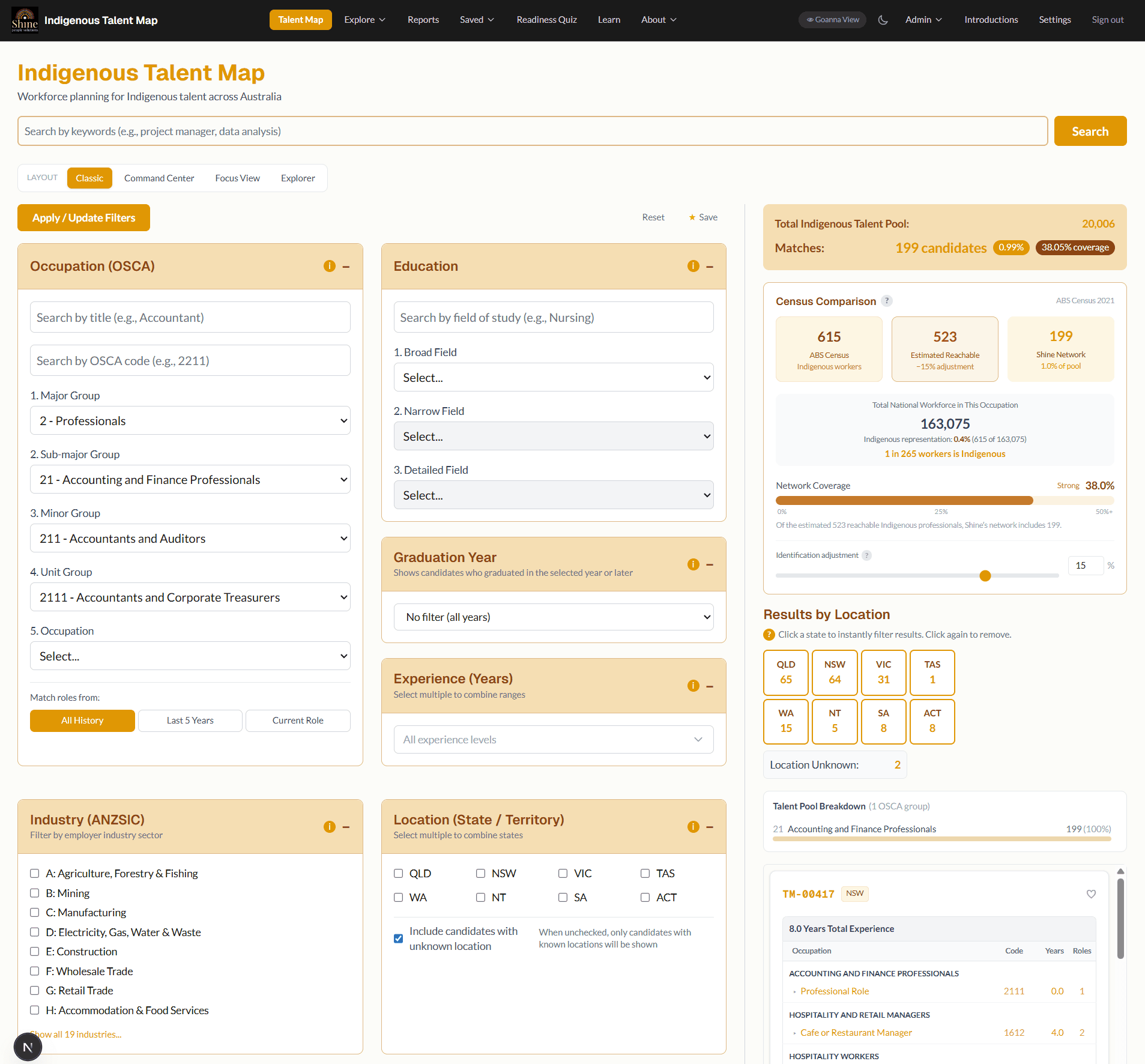
The Indigenous Talent Map by Shine People Solutions integrates our proprietary network of over 20,000 Aboriginal and Torres Strait Islander professionals with ABS 2021 Census data. It shows both the reachable talent in our network and that network's scale against the entire national Indigenous workforce for any given occupation.
It is not a job board. It is not a database of individual candidates. It is a strategic workforce intelligence platform that answers the question: “How many Indigenous professionals exist in occupation X in location Y, and what's our reach as a percentage of the national pool?”
All data is de-identified; no individual candidate names, contact details, or personally identifiable information is displayed. Your Shine consultant has access to the full, rich underlying data for deeper insight and candidate introductions.
Curious how we map free-text job titles to OSCA codes? Read our classification methodology →
Who Is the Talent Map For?
From IPP tender compliance to RAP workforce planning, the Talent Map serves every organisation that needs to understand the Indigenous talent landscape.
Government Contractors (IPP)
Bidding on or delivering a Commonwealth contract over $7.5M?
The Indigenous Procurement Policy requires 4% Indigenous workforce for major government contracts. Whether you're bidding or delivering, demonstrate feasibility and track progress with data-driven workforce intelligence.
The Challenge
Companies bidding on or delivering Commonwealth contracts worth $7.5M+ in 19 specified industry categories must achieve 4% Indigenous workforce (FTE) or 4% Indigenous subcontracting. Without workforce data, you cannot assess whether sufficient Indigenous talent exists before submitting your bid, or plan how to deliver on that commitment once you win.
How the Talent Map Helps
- Enter job titles from your tender scope and AI automatically maps them to correct occupation codes
- See how many Indigenous professionals exist in the required occupations and locations
- Generate a professional IPP Tender Feasibility Report, print to PDF, and attach to your tender response
- Track your Indigenous workforce percentage throughout contract delivery against the 4% target
- Identify gaps and use occupation gaps analysis to plan targeted recruitment or training programs
- Save search criteria and re-run for similar contracts in the future
Tender Evaluators & Procurement Teams
Can this contractor actually deliver on their Indigenous employment commitments?
If you are responsible for evaluating tenders that include Indigenous employment targets, the Talent Map helps you assess whether a tenderer's workforce commitments are realistic and evidence-based.
The Challenge
Tender evaluators often receive Indigenous employment commitments from bidders without any way to verify whether sufficient Indigenous talent actually exists for the roles and locations specified. This makes it difficult to distinguish genuine, achievable plans from aspirational claims that are unlikely to be delivered.
How the Talent Map Helps
- Independently verify whether Indigenous talent pools exist for the occupations and locations a tenderer is committing to
- Compare a tenderer's claimed workforce targets against actual Census data and market intelligence
- Understand which occupations have deep Indigenous talent pools and which have genuine scarcity
- Use IPP Tender Feasibility Reports as a benchmark when assessing tenderer submissions
- Set informed expectations for Indigenous employment conditions in contract requirements
Organisations with a RAP
Turning your RAP employment targets into evidence-based strategy
Over 1,300 organisations have Reconciliation Action Plans. Whether you have formal employment targets or are simply exploring Indigenous-specific roles, workforce intelligence helps you plan with confidence.
The Challenge
Stretch and Elevate RAPs require quantified employment targets. Without data, organisations either set aspirational but unachievable targets (leading to RAP failure) or timid targets that Reconciliation Australia pushes back on. Average Indigenous employment across surveyed companies is just 2.2% against a 3.3% parity rate.
How the Talent Map Helps
- Set evidence-based employment targets per occupation and department
- Generate RAP Workforce Reports with Census benchmarking and under-identification insights
- Create combined multi-department reports from saved searches: one document for your entire RAP workforce plan
- Print professional reports for board reporting, strategic planning and executive briefings
Government Agencies
Meeting Indigenous employment targets with data
Commonwealth, state, and local government agencies with Indigenous employment strategies can use workforce intelligence to inform recruitment campaigns and graduate programs.
The Challenge
Many government agencies have specific Indigenous employment targets (e.g. APS 5% target) but lack the workforce data to understand where Indigenous talent exists for the roles they need to fill.
How the Talent Map Helps
- Understand Indigenous talent availability across all occupations in your agency
- Plan targeted graduate programs and recruitment campaigns based on talent pool data
- Benchmark your reach against the national Indigenous workforce using Census data
- Generate Sector Snapshot reports for strategic planning and executive briefings
Mining & Resources
Your native title agreement includes Indigenous employment obligations
Mining companies with Indigenous engagement commitments need to understand available talent pools, especially in remote regions where traditional recruitment channels have limited reach.
The Challenge
Mining companies often have Indigenous employment commitments as part of land use agreements, native title agreements, and social licence obligations. They need to know what talent exists in remote and regional locations.
How the Talent Map Helps
- Filter by state/territory and occupation to assess local talent availability
- Use blue-collar occupation gaps analysis for trades and operational roles
- Review experience bands to plan a mix of experienced hires and traineeships
- Generate workforce reports for community benefit plan reporting and board papers
Universities & TAFEs
Design scholarships that fill real workforce gaps
Use occupation gap analysis to identify which qualifications are most needed by Indigenous communities and align scholarship offerings with genuine workforce demand.
The Challenge
Education providers want to fund Indigenous scholarships that make a real difference, but without workforce data, scholarship programs may not align with actual employment gaps.
How the Talent Map Helps
- Browse Occupation Gaps to find roles with high Census employment but low recruitment network coverage
- Cross-reference with the ASCED Education Explorer to identify related qualifications
- Design scholarships in high-gap fields (e.g. Environmental Science, Surveying, Engineering)
- Generate Sector Snapshot reports showing workforce demand by education field
Researchers & Academics
A new lens on Indigenous workforce under-identification
Academic and policy research into Indigenous employment has historically relied on ABS Census data alone. The Talent Map provides a complementary, continuously updated data source with occupation and industry classification.
The Challenge
ABS Census data is published infrequently and known to undercount Indigenous Australians by 17.4%. Researchers need complementary data sources to triangulate workforce estimates and study under-identification patterns.
How the Talent Map Helps
- Side-by-side comparison of recruitment network data against ABS Census figures
- Occupation Gaps Analysis reveals potential under-identification in specific professional fields
- Reports include citations to Gari Yala, ABS Post-Enumeration Survey, and DCA/Jumbunna research
- Generate Sector Snapshot reports for use in research papers and policy submissions
State Government IPP Equivalents
(NSW) AIPP, (QLD) Buy Queensland, (WA) Aboriginal Procurement Policy
The same workforce data and reports that support Federal IPP compliance apply directly to state-level Indigenous procurement and employment policies across every Australian jurisdiction.
The Challenge
State-level procurement policies vary in name and detail, but the core question is the same: "Is there Indigenous talent available for this contract?" Contractors bidding on state government work need the same workforce intelligence. Queensland's Buy Queensland initiative has been updated to the Queensland Procurement Policy 2026 (QPP 2026), which commenced 1 January 2026, while (NSW) AIPP and (WA) Aboriginal Procurement Policy continue to drive Indigenous employment in major state contracts.
How the Talent Map Helps
- IPP Tender Feasibility Reports work for any government level: Federal, State, or Local
- Filter by specific state/territory to assess local talent availability
- Covers (NSW) AIPP, (QLD) Queensland Procurement Policy 2026 (QPP 2026, from 1 January 2026), (WA) Aboriginal Procurement Policy, VIC Social Procurement Framework, SA and NT policies
- Save criteria for re-use across similar state government tenders
32+ Features for Workforce Planning
From intelligent search to cultural safety assessments, every feature is designed to turn Indigenous workforce data into actionable intelligence.
Find, explore, and understand the Indigenous talent landscape
Talent Map Search
Find exactly the talent you need
Search 20,000+ Indigenous professionals by occupation, education, industry, location, and experience.
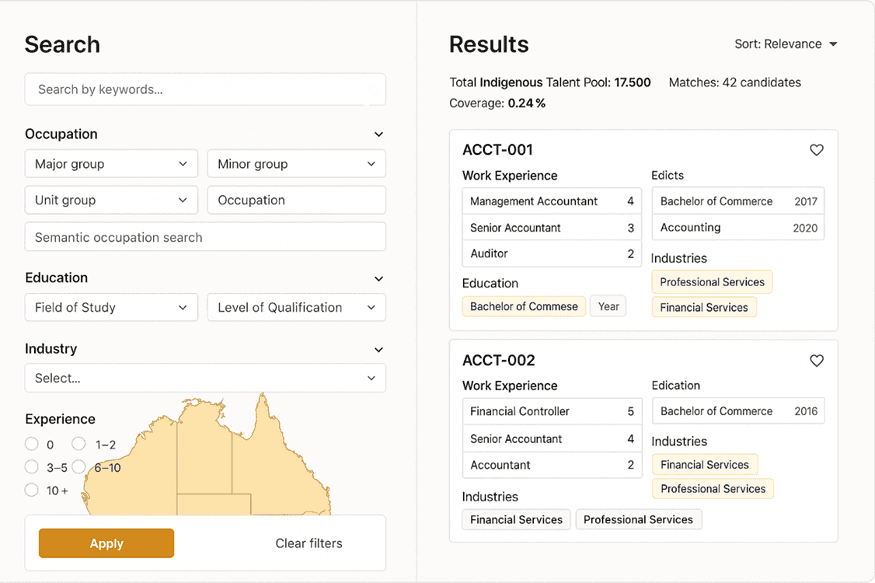
Combine OSCA occupation (5-level hierarchy), ASCED education (3-level), ANZSIC industry (19 categories), location, and experience filters. Four dashboard layouts (Classic, Command Centre, Focus View, Explorer) let you work the way you prefer. All filters combine in real-time with live candidate count updates.
Interactive State Map
See where the talent is, instantly
Click any state or territory to filter results by location with live candidate counts.
Click any state or territory on the interactive map to filter results by that location. Candidate counts update live, giving you immediate geographic intelligence. Combined with the Talent Pool Breakdown charts, you can drill into any cohort in seconds.
AI Job Title Classifier
Just type the job title
Enter plain-English job titles and AI maps them to correct OSCA occupation codes.
Enter plain-language job titles (e.g. 'site foreman', 'project engineer') and the AI instantly maps them to the correct OSCA occupation codes. Removes guesswork from report setup and ensures you search for the right roles, with no need to understand classification systems.
OSCA, ASCED & Industry Explorers
Browse every occupation, qualification, and industry
Interactive trees for 1,100+ occupations, education fields, and 19 ANZSIC industries with live counts.
Navigate all occupations in a 5-level interactive tree, browse education fields in a 3-level hierarchy, or explore all 19 ANZSIC industries with live candidate counts. Each explorer links directly to filtered talent search: one click from browsing to analysis.
Learn & Support Centre
Self-serve training built into the platform
Written guides for every feature, FAQ section, and an AI-powered help bot.
Step-by-step written guides for every feature, a comprehensive FAQ section, and an AI-powered help bot that answers natural-language questions in real time. Clients self-onboard without needing Shine to schedule training sessions.
De-Identification & Privacy
No names. No contact details. No PII. Ever.
Every candidate record is de-identified before it enters the platform.
Sequential TM-XXXXX IDs replace names. State-level location only. No email addresses, phone numbers, or identifiable information. Privacy is the architecture, not an afterthought.
How It Works
Four steps from workforce question to evidence-based answer.
Explore & Discover
Search by occupation, education, industry, location, and experience level. See real-time candidate counts update as you refine your filters. Use the AI Job Title Classifier to convert plain-English job titles into occupation codes.
Benchmark & Contextualise
Compare your search results against ABS Census data to understand what percentage of the national Indigenous workforce your search covers. Occupation gaps analysis reveals untapped talent pipelines and strategic opportunities.
Strategise & Report
Generate professional reports (IPP Tender Feasibility, RAP Workforce, Sector Snapshot, Company Workforce) ready to attach to tender responses, board papers, or RAP documentation. Save search criteria and build a library of workforce intelligence.
Connect & Recruit
Move from insight to action with two recruitment pathways. Use Talent Connect to request a culturally appropriate first approach to a candidate (talent connection fee applies). Or use Shine People Solutions End-to-End Recruitment, where Shine manages the full recruitment process on your behalf.
Nothing Else Like It in Australia
The Indigenous Talent Map occupies a unique position. No other tool combines proprietary recruitment intelligence with Census benchmarking in an interactive, self-service platform.
| Alternative | What It Does | What's Missing |
|---|---|---|
| Supply Nation | Lists Indigenous-owned businesses | Not individual talent intelligence: businesses, not professionals |
| ABS Census (TableBuilder) | Raw Indigenous employment statistics | Not interactive, not enriched with recruitment data, published infrequently |
| Job Boards (Seek, Indeed) | Show who applies for advertised roles | Not strategic workforce planning: applicant flows, not workforce intelligence |
| LinkedIn Talent Insights | General workforce analytics | No Indigenous-specific lens, no Census benchmarking, no de-identified data |
| ATS/CRM Platforms | Track candidates already in your pipeline | Not strategic intelligence across the whole market: your pipeline only |
| CSIRO Indigenous Jobs Map | Maps job opportunities to Indigenous skills (demand side) | Maps jobs to people, not people to jobs; complementary research tool, not a recruitment or planning platform |
The Indigenous Talent Map is the only tool that combines proprietary Indigenous recruitment intelligence, ABS Census benchmarking, AI-powered classification, and professional report generation in a single self-service platform.
Complementary to government research: CSIRO's Indigenous Jobs Map maps job opportunities to Indigenous skills (the demand side). The Indigenous Talent Map maps Indigenous professionals to occupations and locations (the supply side). Together they provide a complete picture of Indigenous workforce demand and supply across Australia.
3 Ways to Use the Talent Map
Workforce Planning
Self-Service Intelligence
Australia's only Indigenous workforce planning platform. Map talent pools across every occupation, benchmark against national Census data, and generate board-ready reports for tenders, RAP documentation, and strategic planning, all in a self-service environment available to every tier.
Talent Connect
Client-Led Introductions
Found a candidate you want to connect with? Shine makes the first move. We handle the culturally safe outreach, gauge interest, and facilitate a consented introduction, leaving you to lead the recruitment process from there. Available from Koala tier.
End-to-End Recruitment
Shine-Managed
Let Shine manage everything. From candidate identification through to engagement, fit assessment, and recruitment process design. Our experienced consultants handle the full journey so you can focus on making the right hire. Available from Koala tier.
Explore Your Access Options
Four tiers from self-service workforce intelligence through to full strategic partnership. See what's included at each level.
Workforce Insights at Your Fingertips
The Indigenous Talent Map helps you answer questions that no other tool can.
How many Indigenous professionals are in my target occupation and location?
What percentage of the national Indigenous workforce can we reach?
Which occupations have the deepest Indigenous talent pools?
Where are the gaps between Census data and known professionals?
What qualifications do Indigenous professionals hold in my sector?
How experienced is the Indigenous talent pool for my target roles?
How do I meet the 4% Indigenous workforce requirement for my IPP contract?
Where should we set our RAP Stretch employment targets?
What Indigenous talent is available in the construction sector in NSW?
How many Indigenous engineers are in Western Australia?
What's the Indigenous talent pipeline for health professionals in Queensland?
Which occupations have the strongest Indigenous professional representation?
How Coverage Works
Example: If the ABS Census records 400 Indigenous accountants nationally and Shine's network includes 148, the coverage is 37%.
This means Shine People Solutions has visibility of over a third of the entire national Indigenous accounting workforce. No other workforce planning tool in Australia offers this level of reach into the Indigenous professional market.
Census data is from the ABS 2021 Census, linked via official OSCA occupation codes. The 17.4% Census undercount means true coverage may be even higher.
Transparency & Privacy
All data in the Talent Map is de-identified. We show aggregated talent pool sizes and coverage percentages, not individual profiles. The platform is built on a privacy-first architecture with one-way hashing and no personally identifiable information in the analytics database. Your Shine consultant can provide deeper insight where needed.

See the Talent. Plan the Pipeline.
Whether you're bidding on (or delivering) a $50M government contract, setting RAP employment targets, or planning Indigenous workforce strategy, the Talent Map gives you the intelligence you need.
Trusted by Industry Leaders